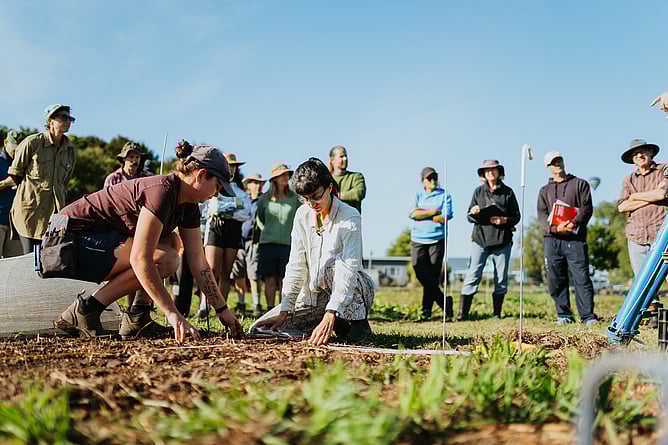
2025 Reflection and 2026–2028 Trajectory
Over the past three years, The Jenkins Foundation support has been instrumental in allowing Earthworkers to evolve from a small, grassroots education initiative into what we believe will become a nationally significant biology-first regenerative education pathway.
What you have helped build is no longer a single programme, but an integrated learning ecosystem - one that now spans beginner growers, small-to-medium producers, and, from 2026 onward, commercial growers and emerging agronomists who will be trained.
We acknowledge your continued support during a period of organisational reflection and change. Midway through your funding, Earthworkers undertook a necessary pause to reassess our direction and listen closely to the needs of the communities we serve. Your willingness to stay engaged during this time, and to actively contribute ideas, including the development of an alumni blog, enabled us not only to continue, but to evolve with clarity and purpose. Over the past twelve months, this support has helped translate reflection into action, resulting in a strengthened education pathway, a new digital platform, and practical mechanisms for sharing grower knowledge. We see this period as foundational to the work ahead, allowing us to move forward with greater alignment, resilience, and long-term impact.
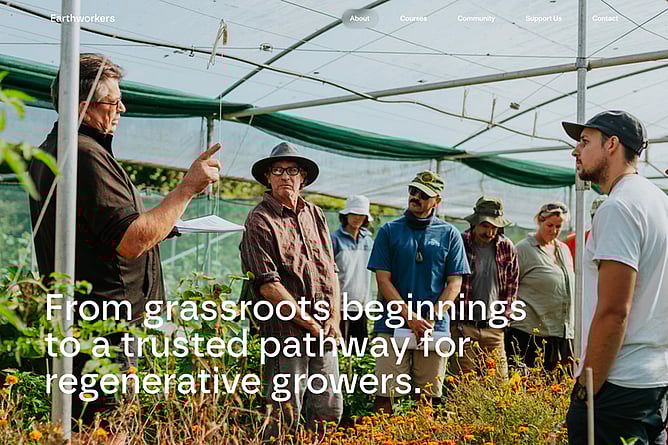
Earthworkers new digtal platform
What We Achieved Together 2025
This year marked a critical proof-of-concept phase. Rather than teaching solely from our own model farm, we intentionally tested whether Earthworkers Hort 101 could be delivered on alumni farms, across regions, and at different scales.
We ran two highly successful courses:
Kirikiriroa (Hamilton) — hosted across three alumni farms: Tomtit, Earth Stewards, and Ethos
Pōneke (Wellington) — delivered across Kai Cycle, Māngaroa Farm, Mahinga Kai, and Innermost Gardens, supported by Wellington City Council as part of Te Anamata ā Kai
This shift delivered clear benefits:
Participants experienced regenerative practice at multiple scales, not just in theory
Host farms received in-depth, on-site agronomic consultation from Daniel Schuurman as part of the teaching process
In every case, significant soil and system issues were identified, with practical solutions that materially improved farm productivity and resilience
This confirmed something essential: Earthworkers’ model works beyond Auckland, beyond our own land, and within real farming systems under real pressure.
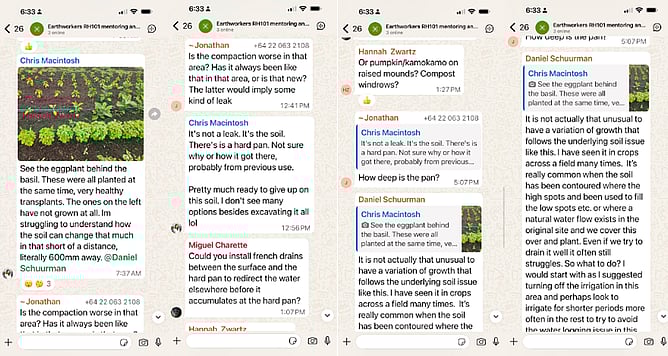
Our Earthworkers WhatApp "Living Classroom" in action
Living Classroom
We continued to support over 320 Earthworkers alumni, with approximately 150 growers engaging daily in our WhatsApp "Living Classroom." This long-standing peer mentoring network, overseen by agronomy lead Daniel Schuurman, enables growers to share knowledge, troubleshoot challenges, and remain committed to biology-first practices, often at moments when outcomes are finely balanced. In 2026, we plan to activate this valuable archive through social media and AI-supported tools, making its insights more accessible to both our community and the wider public.
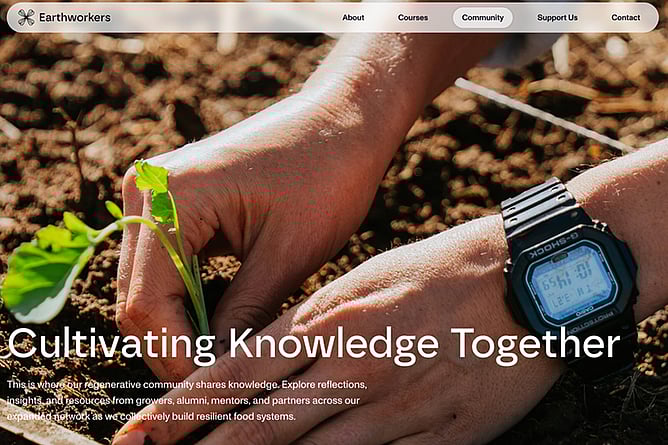
Earthworkers new community blog, Cultivating Knowledge Together
Community storytelling and knowledge sharing (with your encouragement)
In response to The Jenkins Foundation’s interest in sharing lived grower experience, we created a new Community blog, Cultivating Knowledge Together. The first blog, “Loving soil, but also learning soil” by Earthworkers alumna Jenny Lux (Lux Organics), is now live. This writing does more than tell a story: it demonstrates how Earthworkers alumni deepen their practice over time and step into leadership, mentoring, and agronomic roles.
This blog is now being:
Shared across Earthworkers communications
Integrated into Organic Aotearoa’s online magazine, extending its reach beyond our immediate network and making alumni knowledge visible to the wider sector
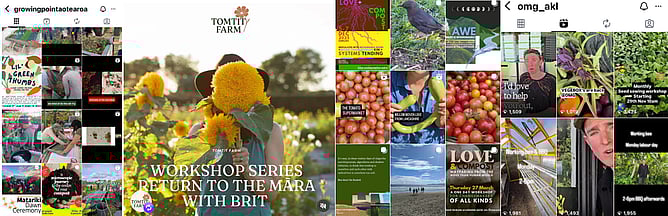
Social media feeds from our alumni farms
Our Alumni teaching from their own farms
We see the emergence of alumni-led courses and workshops as a meaningful signal that knowledge is taking root and being carried forward through community rather than centralised delivery.
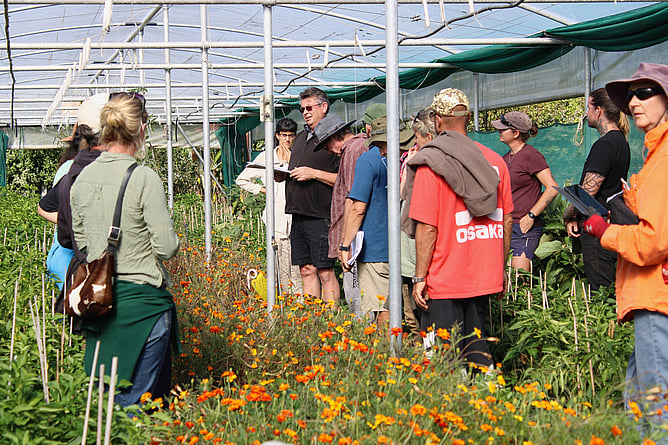
On site at Earth Stewards Farm
2025
A new Earthworkers platform (earthworkers.org) - purpose-built to support education delivery, alumni connection, and knowledge-sharing at scale
Cultivating Knowledge Together (Community Blog) - a new publishing platform where alumni, growers, and mentors share first-person reflections and practical insights, making lived regenerative knowledge visible and accessible
The formal development of Hort 201 (Advanced Regenerative Horticulture) - funded by Eurofins International and designed to support commercial growers to deepen biology-first practice with confidence
The design of Future Agronomists - a long-term programme to grow biology-first advisors who can mentor others and support regenerative transitions within their regions and sectors
A re-imagined Communities of Regenerative Learning (CORL) - in 2026 this will be integrated into a longer, more sustainable pathway linked to Future Agronomists, creating real-world mentoring opportunities within the Earthworkers network rather than stand-alone programmes
A living “classroom” through our WhatsApp mentoring network - where over 150 alumni actively troubleshoot, share observations and data, and increasingly support and mentor one another in daily growing practice. In 2026 this will be evolved to support the wider community while making the archive more accessible to our own community
The emergence of alumni-led courses and workshops - as alumni begin hosting their own entry-level learning spaces, extending Earthworkers’ impact into local communities and demonstrating knowledge taking root beyond our direct delivery
In parallel, Earthworkers’ work is now being recognised and amplified by aligned organisations including Organic Aotearoa, Organic NZ, Biodynamics NZ, Eat New Zealand, and leading regenerative farms such as Earth Stewards Fram, Lux Organic Māngaroa and Live to Give.
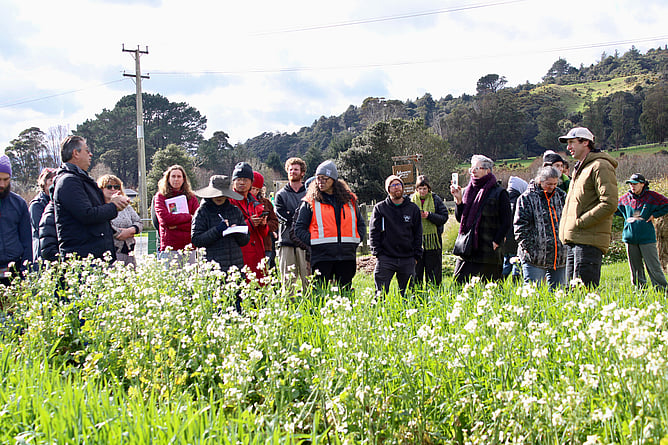
On site at Earth Stewards Farm
Why this matters
Growers across Aotearoa are facing unprecedented pressure:
rising costs of production
increasing climate volatility
tightening nitrate and environmental constraints
evolving organic certification requirements
uncertainty around emerging technologies and market expectations
What is often missing is practical, trusted, biology-first education that empowers growers to adapt - not just comply.
Earthworkers is preparing to fill this gap
Daniel’s day-to-day work supporting commercial growers has shown that many are already applying regenerative principles, but without the underlying understanding of why those practices work. Our education pathway is designed to change that: to move growers from dependency on advisors to confidence, literacy, and leadership within their own systems.